
Bank credit offtake is expected to pick up following normalisation of economic activities aided by the government thrust on public expenditure in current fiscal year, a report said. According to the Care Edge report, the gross non-performing assets (GNPA) ratio hit a six-year low of 5.9 per cent in FY22 but remained above the pre-asset quality review of 2015-16. However, it said, India's NPA ratio is one of the highest among the comparable countries despite gradual decline.

If warranted they can initiate criminal proceedings including filing of FIR, a Finance Ministry official said.

Banks will also have to seek borrower's status report from Central Economic Intelligence Bureau on the account turning NPA

The country's largest lender SBI on Friday reported an 80 per cent surge in standalone net profit at Rs 6.450.75 crore for the fourth quarter ended March 2021, aided by decline in bad loans. State Bank of India (SBI) had registered a profit of Rs 3,580.81 crore during January-March period of 2019-20, the lender said in a regulatory filing. Total income of the bank during the March quarter of the last financial year rose to Rs 81,326.96 crore, from Rs 76,027.51 crore in the same period of 2019-20.

Total income on a standalone basis increased to Rs 1,74,972.96 crore.

The scrip was the worst hit among the front-line companies on both the indices during the day.

Yes Bank on Saturday reported over two-fold jump in standalone net profit at Rs 452 crore for March quarter 2023-24, primarily due to benefits on the provision front. In the year-ago quarter, the bank logged a profit of Rs 202.43 crore. The private sector lender benefitted from write-back on income tax and interest on income tax returns, but the profits were limited by its inability to comply with the mandatory priority sector lending (PSL) requirements, its management said.

The gross non-performing assets of public sector banks rose to 6.03% at the end of June.

The government on Friday doubled the limit of Mudra loan amount under the Pradhan Mantri Mudra Yojana (PMMY) to Rs 20 lakh from Rs 10 lakh under a new 'Tarun Plus' category to promote entrepreneurship in the country.

Poor earnings show in the September quarter (Q2FY24), with hints of likely weakness in asset quality going ahead, forced analysts to cut earnings estimates of SBI Cards and Payment Services (SBI Card). On the bourses, shares of the State bank of India arm tumbled 7.4 per cent to Rs 732 apiece on the BSE in the intraday trade as investors factord in near-term concerns. Analysts at Motilal Oswal Financial Services, for instance, slashed SBI Card earnings by 8 per cent and 10 per cent for FY24 and FY25, respectively, as they expect the company to face pesistent magin pressure.

Treasury gains helped ICICI Bank post a nearly 10 per cent increase in the consolidated net profit for the April-June quarter at Rs 11,696 crore on Saturday. Growth in the core income slowed for the country's second largest private sector lender, but the treasury operations helped it report a 14.62 per cent rise in its post-tax profit at Rs 11,059 crore on a standalone basis. The core net interest income (NII) growth came at a multi quarter low of 7.3 per cent to Rs 19,553 crore for the reporting quarter.

The total provisioning for non-performing assets rose to Rs 3,428.59 crore (Rs 34.28 billion) during the December quarter, up from Rs 2,766.18 crore (Rs 27.66 billion) in the corresponding period last fiscal, SBI said in a filing on the BSE.
The PCA plan covers various suggestions or measures to recover non-performing assets (NPAs), reduce costs, boost capital, downsize risk-weighted assets, and improve profitability, among others. The LVB management is in the process of implementing all of these, said sources.
The country's largest private lender HDFC Bank on Saturday reported a 6.51 per cent decline in its consolidated net profit to Rs 16,474.85 crore in the April-June quarter compared to the previous January-March quarter. The city-headquartered lender, which merged its mortgage major parent HDFC into itself in July last year, had reported a net profit of Rs 17,622.38 crore in the March quarter. On a standalone basis, the net profit declined to Rs 16,174.75 crore in April-June 2024-25 from Rs 16,511.85 crore in January-March 2023-24.

In a filing to stock exchanges, BoI said Reserve Bank of India has placed it under Prompt Corrective Action Framework, consequent to the onsite inspection under the risk based supervision model carried out for the year ended March 2017.

The meeting with the top officials of public sector banks is scheduled for March 5, a senior finance ministry official told PTI.

Punjab National Bank has the largest share.

Axis Bank has strengthened its positioning -- on both the assets and liability side -- and it may be set to deliver sustained improvement in performance. The valuation gap between Axis Bank (which trades at 1.4x core book value (or BV) and peers like ICICI Bank (valued at 2x BV) is expected to narrow.
ICICI Bank on Saturday said its March quarter consolidated net profit grew 18.5 per cent to Rs 11,672 crore, helped by lower provisions. On a standalone basis, the second largest private sector lender showed a 17.4 per cent growth in its profit after tax at Rs 10,708 crore for the reporting quarter against Rs 9,122 crore in the year-ago period. For fiscal 2023-24, its standalone net profit grew to Rs 40,888 crore from Rs 31,896 crore a year ago.

Total income for the quarter ended March 31, 2019, stood at Rs 31,204.5 crore, up by 22.1 per cent from Rs 25,549.7 crore for the quarter ended on March 31, 2018,

Its total income (consolidated) rose to Rs 79,302.72 crore in the quarter under review, compared to Rs 74,948.51 crore in the year-ago period

Jaitley said there was a need for the banking sector to fund infrastructure and manufacturing sectors to support the ambitions of higher growth.

The eligibility for loan issuance for salaried individual for car purchase has been raised from Rs 250,000 per annum to Rs 600,000 per annum, as per the recent circular of the bank.

The country's largest lender State Bank of India on Monday said it has reduced interest rates on home loans by up to 10 basis points (bps) and is offering loans starting from 6.70 per cent rate. The new rates are based on loan amount and CIBIL score of the borrower, and are available till March 31, 2021, according to a statement. The bank said the home loan interest rates will start from 6.70 per cent for loans up to Rs 75 lakh and 6.75 per cent for loans in the range of Rs 75 lakh-Rs 5 crore.

The Indian financial system's asset quality improved despite the pandemic, but it could be due to special dispensations by the regulator, and banks would likely see increased stress on their books once the schemes expire. According to the annual trend and progress report of the Reserve Bank of India (RBI) released on Tuesday, the data available for this financial year so far indicate that banks' bad debts have moderated while provision coverage ratios (PCRs), capital buffers as well as profitability indicators have improved relative to pre-pandemic levels.

After declining to a three-year low in FY24, the private sector investment is expected to fall further in the current financial year, India Ratings said in a research note.. The investments in the private sector are likely to plummet to below 11 per cent of the GDP in FY25, based on the trends from the latest national accounts data and company fillings, it noted.
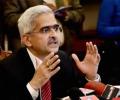
He said the impact of the second wave of COVID-19 has waned by August,and economic growth will be better from the second quarter onward on a sequential basis. Speaking at an event organised by The Indian Express and Financial Times, Das said the RBI has decided to give more emphasis on growth because of the pandemic and operate in the 2-6 per cent inflation band set by the government for it. The central bank will seek to gradually move towards achieving the 4 per cent target over a period of time, he said, adding that the possibility of a sustained increase in inflation is unlikely.

Private sector banks reported a robust profile with healthy growth in net interest income (NII), credit offtake and reduction in provision burden for the fourth quarter ended March 2023 (Q4 of FY23). However, as a pack, their net profit declined by 9.7 per cent year-on-year (YoY) at Rs 25,317 crore in Q4. This is because Axis Bank posted losses due to its one-time hefty charge for the acquisition of Citibank India's consumer business.

Though Indian banks don't have large exposure to subprime mortgages, analysts are worried at the rise in their restructured loan portfolios and deterioration in credit quality.
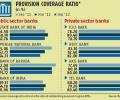
Amid a rise in non-performing assets, most public sector banks have seen a substantial drop in their provision coverage ratio in the year since the reserve Bank of India (RBI) withdrew the 70 per cent provision coverage ratio norm.

The country's largest lender State Bank of India (SBI) on Wednesday reported a 55 per cent increase in consolidated net profit at Rs 5,245.88 crore for the second quarter ended September 30 on account of decline in bad loans. The bank's net profit stood at Rs 3,375.40 crore in July-September quarter of the previous fiscal, SBI said in a regulatory filing.

'Although we are facing constraints related to lending and resource mobilisation, the government is aware of these.'

Bank had registered a standalone net profit of Rs 1,263 crore in the same period a year ago

The health of Indian banks continued to improve in 2021-22 with their balance sheet growing at double digits after a gap of seven years and their asset quality and capital position bettering, the Reserve Bank of India (RBI) said in its annual report on trend and progress of banking in India. At the same time, the banking regulator flagged the issue of slippages from restructured accounts. "Going forward, it is imperative that banks ensure due diligence and robust credit appraisal to limit credit risk," the report said.

Banks' bad loans might cross Rs 10 lakh crore by the end of this fiscal, mainly on account of slippages in retail and MSME sectors, a study said on Tuesday. "NPAs are expected to rise to 8.5-9 per cent by March 2022, driven by slippages in retail, Micro, Small and Medium Enterprise (MSME) accounts, besides some restructured assets," the study by industry body Assocham and ratings firm Crisil said. The study titled 'Reinforcing the Code' said the Gross Non-Performing Assets (GNPAs) of banks are expected to cross Rs 10 lakh crore by March 2022.
Public sector banks have raked in more profits in the three months ended June on the back of a persistent decline in bad loans and the trend may have a positive bearing on their balance sheets in the coming quarters. In the June quarter, Bank of Maharashtra (BoM) and State Bank of India (SBI) were in the lowest quartile as far as Gross Non Performing Assets (NPAs) and net NPAs were concerned, according to an analysis of the quarterly financial numbers published by the public sector lenders. Cumulatively, all the 12 public sector banks reported a profit of about Rs 15,306 crore in the three months ended June, registering an annual growth of 9.2 per cent. However, leading public sector lenders -- SBI and PNB -- posted lower profits in the June quarter.

RBI said the improvement in asset quality was driven by state-run lenders which saw a drop both in both GNPA and in the net NPA ratios.

Paving the way for takeover of crisis-ridden Punjab and Maharashtra Cooperative Bank (PMC), the Reserve Bank of India on Friday granted in-principle approval to the Centrum Financial Services to set up a small finance bank. Centrum Financial Services was one of the applicants for takeover of the PMC Bank. "This 'in-principle' approval has been accorded in specific pursuance to the Centrum Financial Services Limited's offer dated February 1, 2021, in response to the expression of interest notification (November 3, 2020) published by the PMC Bank Ltd," the RBI said in a statement.

'As these segments are growing at 25 per cent for the last three years, credit quality has been extremely good.'

Sashidhar Jagdishan, managing director and chief executive officer of HDFC Bank, the largest private-sector lender of the country, has just completed his first term. The period October 2020-October 2023 was a roller coaster, and the second one, which started on October 27, could be more interesting as the lender absorbs the impact of the merger of HDFC, which was integrated on July 1, and moves to the next growth phase. Soon after he took over the reins from Aditya Puri on October 27, 2020, the Reserve Bank of India (RBI) debarred HDFC Bank from enrolling new credit card customers and launching new products under the Digital 2.0 programme due to repeated outages on its mobile-banking and internet-banking platforms.
